
Give your Head of Sales one main target: the revenue signed by their whole team, not just their own. Add 8 key performance indicators (KPIs) that explain that number: pipeline coverage, conversion rates, sales cycle, average deal size, forecast accuracy, the share of the team hitting quota, the ramp-up time of new salespeople and team stability. During the first 90 days, judge them mostly on the structure they put in place. After 12 months, judge them on the number and the indicators. Here is how to set these targets and link them to their variable pay.
The main KPI: the team's number, not their own
A Head of Sales leads a team of salespeople. Their target is therefore that of their scope: the revenue signed by the team, in new customers or in annual recurring revenue (ARR) depending on your model.
Two precautions:
If they still sell themselves at the start, track their own sales separately, with a distinct target. Otherwise, they will be tempted to sign in place of their salespeople instead of helping them progress.
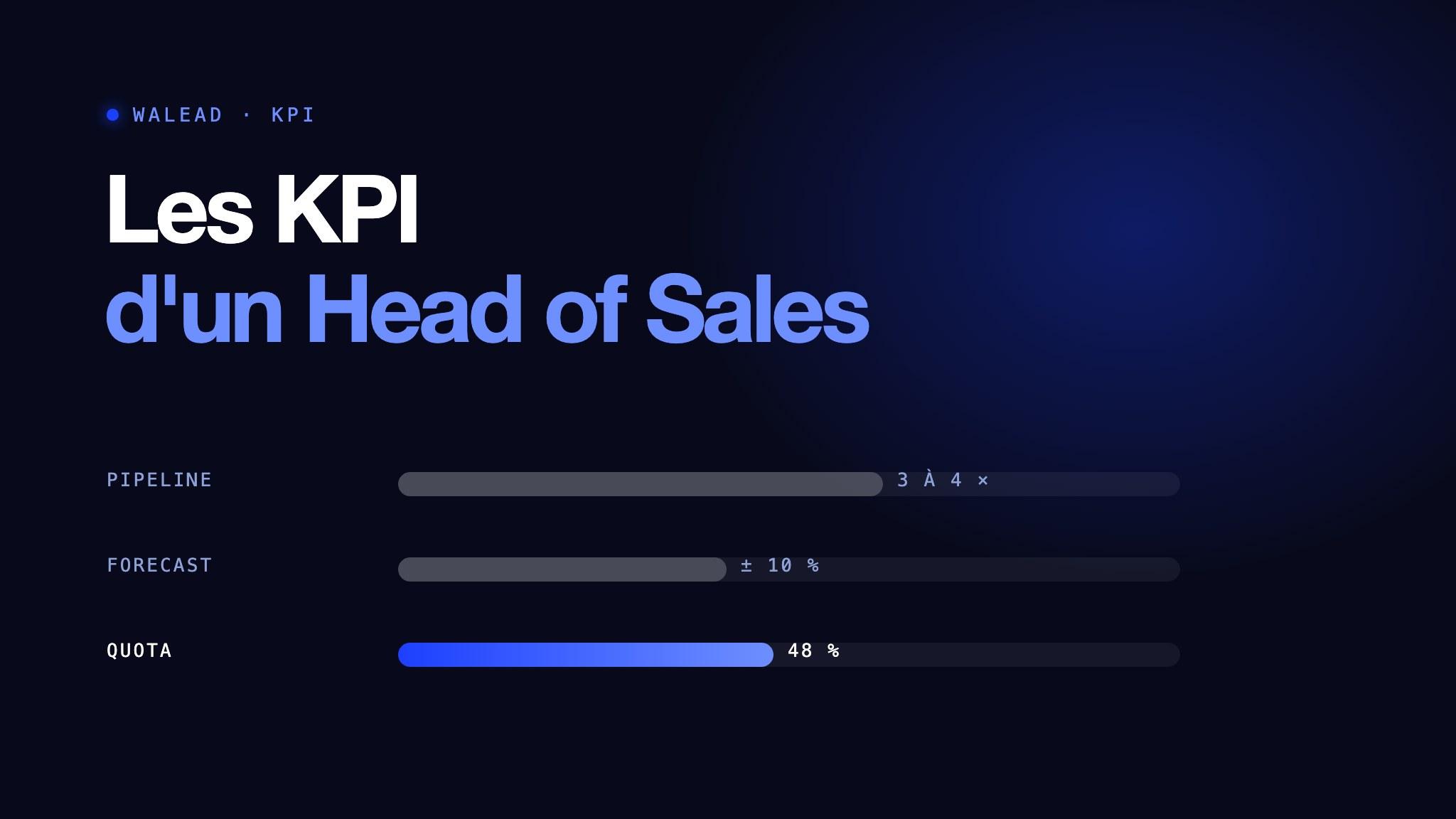
Build a margin into the team's target. Not all salespeople hit their target: according to the 2026 study by the American consulting firm The Bridge Group, covering 158 B2B companies, only 48% of Account Executives hit their annual quota. If the team's target is the exact sum of individual quotas, it is very likely to be missed. Set quotas whose sum exceeds the team's target.
The 8 indicators that explain the number
The signed revenue tells you whether the target is hit. The indicators tell you why, and what to fix.
Pipeline coverage. The amount of qualified opportunities, divided by the remaining target. Benchmark: depends on the conversion rate: at 25%, you need 4 times the target.
Conversion rate by stage. The share of meetings that become opportunities, then signatures. Benchmark: track it stage by stage, to see where deals are lost.
Sales cycle. The number of days between the creation of an opportunity and the signature. Benchmark: if it lengthens, next quarter's number is likely to drop.
Average deal size. The average amount of a signed contract. Benchmark: it must stay consistent with your target customers.
Forecast accuracy. The gap between the number forecast at the start of the period and the number achieved. Benchmark: set a maximum gap, for example 10%.
Share of the team at quota. The percentage of salespeople who hit their target. Benchmark: 48% of Account Executives, according to the 2026 study by the American firm The Bridge Group.
Ramp-up time. The time for a new salesperson to become fully productive. Benchmark: 6.2 months on average for an Account Executive, according to the same study.
Team stability. Salespeople who leave over 12 months. Benchmark: each departure costs several months of a replacement's ramp-up.
Two indicators deserve an explanation.
Pipeline coverage. The rule often quoted is to have 3 times the target in pipeline. It assumes winning one opportunity in three. Instead, calculate coverage from your own conversion rate. For example, if you sign 25% of your qualified opportunities, you need about €1.2M, to close within the quarter, to sign €300k of new ARR.
Forecast accuracy. This is often the weak point of sales teams: according to a Gartner survey published in 2020, only 45% of sales leaders and salespeople surveyed have high confidence in the accuracy of their company's forecasts. A Head of Sales who announces a number and delivers it lets the CEO steer cash, hiring and fundraising.
What to look at, and how often
Not all indicators are reviewed at the same pace. Here is a simple calendar for your meetings with your Head of Sales.
Every week : The pipeline created, coverage, opportunities that move forward or stall, the forecast for the month and the quarter.
Every month : The signed revenue against target, conversion rates by stage, average deal size, sales cycle.
Every quarter : The share of the team at quota, forecast accuracy, ramp-up of new salespeople, departures, the hiring plan.
Keep the same dashboard from one week to the next. If the indicators change at every meeting, nobody sees the trends.
The 90-day and 12-month targets
A Head of Sales who arrives rarely changes the number within 3 months: the deals signed in that time often come from a pipeline created before them. So set two series of targets.
At 90 days
The goal. Put the structure in place.
The targets. Defined sales stages and an up-to-date CRM; a weekly forecast; an assessment of each salesperson; a hiring and onboarding plan.
How to judge. On the quality of what they have built.
At 12 months
The goal. Improve results.
The targets. The team's revenue target achieved; a reliable forecast; more salespeople at quota; new salespeople productive faster; a stable team.
How to judge. On the number and the indicators.
We detail this first period in our article on the first 90 days of a Head of Sales.
Linking KPIs to their variable pay
According to our Sales salary grid, drawn from our 2026 placements, an experienced Head of Sales earns in France €65k to €80k gross per year fixed and €20k to €30k variable, that is €85k to €110k at target. Variable pay therefore represents about a quarter of their pay at target.
To make them push in the right direction:
Tie the largest part of the variable to the team's number, for example 70 to 80%. This is their main target.
Tie the rest to one or two quality indicators, such as forecast accuracy or the ramp-up of new salespeople. No more: a variable split into ten criteria motivates little.
Pay the variable every quarter, on a quarterly target drawn from the annual target.
During the first months, guarantee part of the variable or tie it to structure goals. Otherwise, they will be paid on a pipeline they did not build.
To understand how pay at target is calculated, read our article on OTE and the pay grids from AE to CRO.
Checking in the interview that they can steer these KPIs
The best candidates know their numbers. Ask them:
what share of their team hit its target, and what they did to raise it;
what gap they had between their forecast and the number achieved;
how long it took a new salesperson to become productive;
how many salespeople left, and why.
A candidate who answers with precise figures has probably already led a team with these indicators. Check them during reference checks. Our Sales hiring scorecard helps structure these questions, and our article on the process to hire a Head of Sales details each step.
Mistakes to avoid
Tracking too many indicators: beyond about ten, nobody knows what counts.
Judging a Head of Sales on the number after 3 months: they are still harvesting their predecessor's pipeline.
Setting the team's target as if all salespeople will hit their quota: according to the study cited above, fewer than half of Account Executives do.
Measuring activity instead of results: a number of calls tells you nothing if opportunities do not convert.
Changing targets mid-quarter: the team no longer knows what it is judged on.
Giving a target without the means: hiring budget, tools, marketing support.
Frequently asked questions about Head of Sales KPIs
Which KPIs should I track for a Head of Sales?
One main target: the revenue signed by the whole team. And 8 indicators that explain it: pipeline coverage, conversion rates, sales cycle, average deal size, forecast accuracy, the share of the team at quota, the ramp-up of new salespeople and team stability.
What pipeline coverage should I aim for?
It depends on your conversion rate. The rule of 3 times the target assumes winning one opportunity in three. If you sign 25% of your qualified opportunities, you need about 4 times the target in pipeline.
How do I set a Head of Sales's variable pay?
Tie the largest part of the variable to the team's number, and the rest to one or two quality indicators, such as forecast accuracy. For an experienced Head of Sales, our 2026 grid provides €20k to €30k of variable, for €85k to €110k gross per year at target.
Hiring a Head of Sales: let's talk
We recruit Sales profiles for start-ups and scale-ups, from Account Executive to CRO. Before launching the search, we help you define the role, the targets and a package at market level. We present a shortlist within 5 days, for a full hire within 20 days on average, with a 4-month replacement guarantee. Discover our offers and fees. And if you want to talk about it, book a call: we start from your situation.