
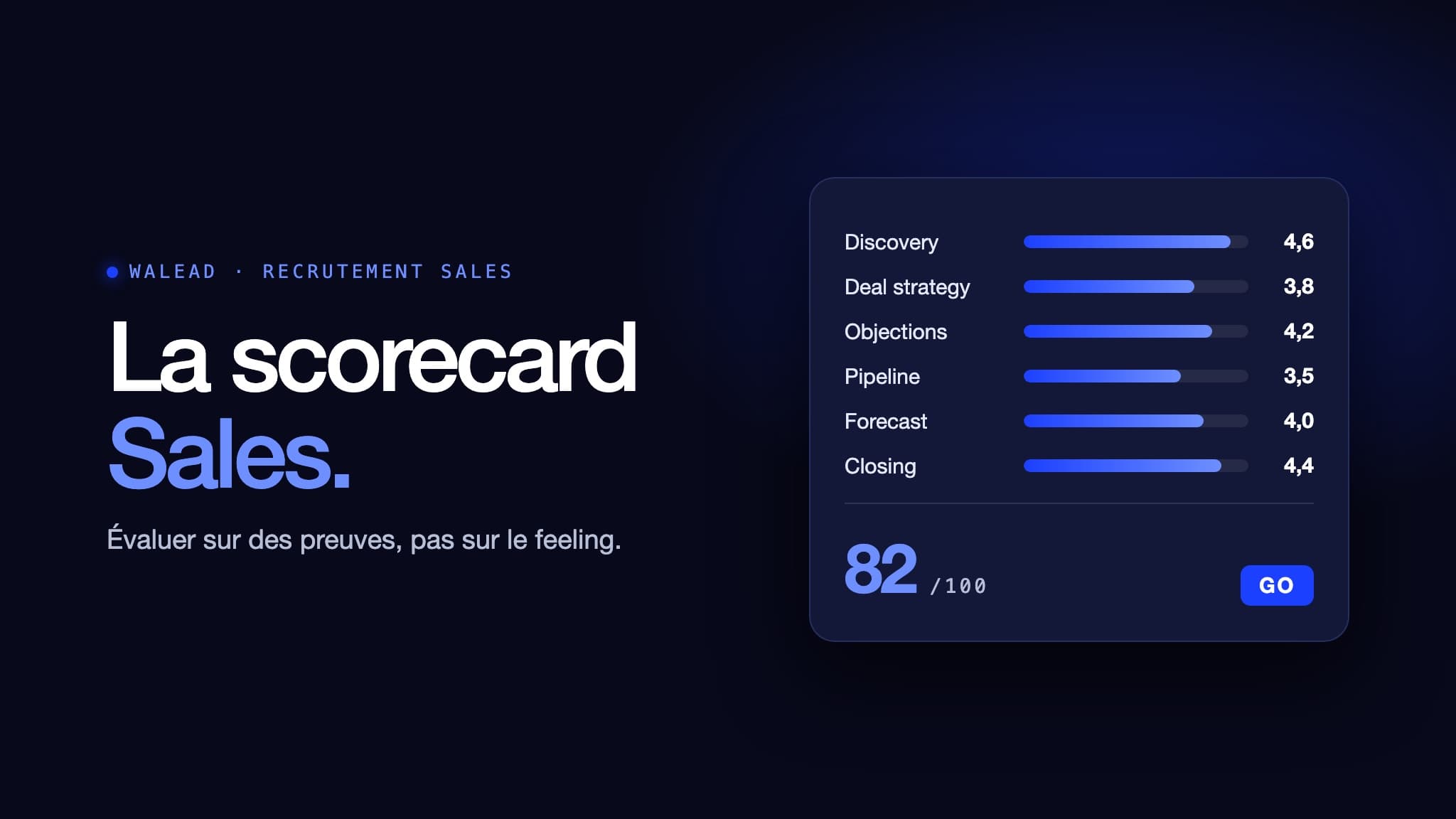
In Sales hiring, the decision too often comes down to a "good feeling". It is the most common justification and the least reliable. A scorecard replaces that impression with the same grid for every candidate: same criteria, same weights, same scores. We laid out the principle in How to evaluate a candidate: the scorecard method. Here we move on to building one, then to the grid we use for an SDR and for an Account Executive.
The golden rule: no proof, no point
If you don't have proof, you don't have a point. Gut feeling is for dessert. In practice, a criterion is only scored if it is backed by a concrete, verifiable example: a number, a document, a dated fact. Not by a statement of intent.
How to build a scorecard in 6 steps
Define the mission of the role. One sentence: why the role exists and what it must produce. For example: "open the mid-market segment and sign the first contracts within 6 months".
Choose 6 to 8 criteria. Each criterion answers one question: what will make someone succeed, or fail, in this role? Beyond eight, the grid becomes unreadable and each criterion loses its weight.
Spread 100 points of weight. The criteria that best predict performance weigh the most. For an Account Executive, past performance weighs 20%, stated motivation far less.
Write two questions per criterion. A broad question to understand the person's reasoning, and a precise one to get a number, a method or a piece of proof.
Set a 1 to 5 scale. 1: red flag, inconsistent answer or no proof. 2: weak. 3: fine, standard. 4: solid, above the expected level. 5: excellent, with proof, clarity and impact.
Compute a score out of 100 and set the decision rule before the interviews. A criterion's weighted score is (score ÷ 5) × weight. In our grid: 75 and above, we move forward (GO); between 65 and 74, we debate; below 65, we stop (NO GO).
Organizing the interviews: three perspectives, 30 minutes each
Each candidate goes through three 30-minute interviews with three people who test different things: the recruiter, the Sales Manager and the Head of Sales. Each has their own 100-point grid. The overall score is the average of the three. They all follow the same plan:
0 to 3 min: set the frame and the context
3 to 10 min: broad questions, to understand the person and their logic
10 to 22 min: precise questions, to get numbers, methods and proof
22 to 27 min: exercise (role play, case, objection handling)
27 to 30 min: candidate questions and next step
Example 1: the SDR scorecard (recruiter interview)
For an SDR, the prospecting salesperson, we first assess the engine: motivation, resilience, ability to learn, discipline. Before the interview, we collect their numbers: monthly meeting target and attainment, meetings booked per month, calls and emails per day, show rate.
Motivation (15%): "Why do you want to do outbound?" then "What do you expect from the role day to day, and what do you refuse to do?"
Resilience (15%): "Your biggest failure?" then "How many rejections in a row have you taken, and how did you keep going?"
Coachability (15%): "Which feedback stung?" then "What did you change concretely afterwards?"
Discipline (15%): "How do you organize your day?" then "Show your plan to reach X meetings a month."
Communication (10%): "Explain your last job in 60 seconds" then "Pitch the product you sold in 30 seconds: value, target, use case."
Curiosity (10%): "How do you research a prospect?" then "Give 5 signals to prioritize an account."
Ethics (10%): "A situation where you refused to push?" then "When do you say no to a manager, and why?"
Energy fit (10%): "What gets you fired up?" then "What do you do when nobody is watching?"
The first four criteria weigh 60% of the total: an SDR is judged first on consistency, not on ease of speech.
Example 2: the Account Executive scorecard
For an Account Executive, we look for proof of performance and ask to verify it (CRM, dashboard, quota email). Numbers to collect: annual quota, attainment over 12 months, average ACV, average sales cycle in days, win rate and pipeline coverage. Our advice: ask for proof before believing the numbers.
Interview 1, the recruiter: the field, performance, fit
Scope (15%): "Describe your last role", then cycle, ACV, target, personas and the share of inbound and outbound.
Performance (20%): "Your attainment over 12 months?", then the strongest month, the proof, and what was done differently.
Clarity (10%): "Explain your product" in two sentences: problem, value, differentiation.
Resilience (15%): "Your hardest quarter?", then what was done, week by week, to recover.
Collaboration (10%): the relationship with SDRs, Customer Success and marketing, and a conflict resolved.
Learning (10%): a skill built, the learning plan and the result.
Ethics (10%): a sale turned down, and why when the quota was not met.
Fit (10%): what drives them, and what drains their energy.
Interview 2, the Sales Manager: the sales mechanics
Discovery (20%): their discovery framework, then a live 5-minute discovery on your product.
Deal strategy (15%): their most complex deal, with the stakeholder map, next steps and risks.
Objections and pricing (15%): handle "it's too expensive" and "we need to think about it" live.
Pipeline (15%): how they build their pipe, the coverage they target and how they reach it.
Forecast (15%): how they forecast, and the difference between commit and best case in their world.
Closing (10%): an example of a written close plan.
Process (10%): how they use the CRM and which data they track every week.
Interview 3, the Head of Sales: vision and impact
Vision (20%): how they would improve sales at your company, with three levers and the metrics to measure them.
Impact (20%): a project beyond their role, with a quantified impact on pipeline, win rate or cycle.
Leadership (15%): how they lift a team, with an example of coaching a peer and the result.
Customer (15%): why deals are lost, the top five reasons lost and how they reduce them.
Pressure (10%): their biggest end-of-month sprint, and how they keep quality under stress.
Collab (10%): their ideal collaboration with marketing, SDRs and Customer Success, and what they concretely ask of marketing.
Integrity (10%): a deal they got wrong, and how they fixed it.
Reading the result: the overall score
The overall score is the average of the three scores out of 100. At 75 or above: GO. Between 65 and 74: debate, look at where the gaps are and decide together. Below 65: NO GO. Example: an Account Executive scores 82 with the recruiter, 74 with the Sales Manager and 71 with the Head of Sales. The average is 75.7: GO. Also write down red flags in a separate list (inconsistent answer, no proof, numbers that cannot be verified): they count in the final discussion.
Mistakes that skew a scorecard
Changing criteria or weights from one candidate to the next: the comparison no longer means anything.
Scoring without proof: a 4 without an example is an impression in disguise.
Having too many criteria: beyond eight, everything weighs the same.
Setting the decision rule after seeing the candidates: you then adjust the threshold to your favorite.
Running the same interview three times: each interviewer must test something different.
Going further with Walead
Our scorecard page details the method and offers a PDF template to download. To put a number on what a failed Sales hire costs, use the calculator. And if you are hiring an SDR, an Account Executive or a Head of Sales, let's talk: we clarify these criteria with you from the scoping brief.