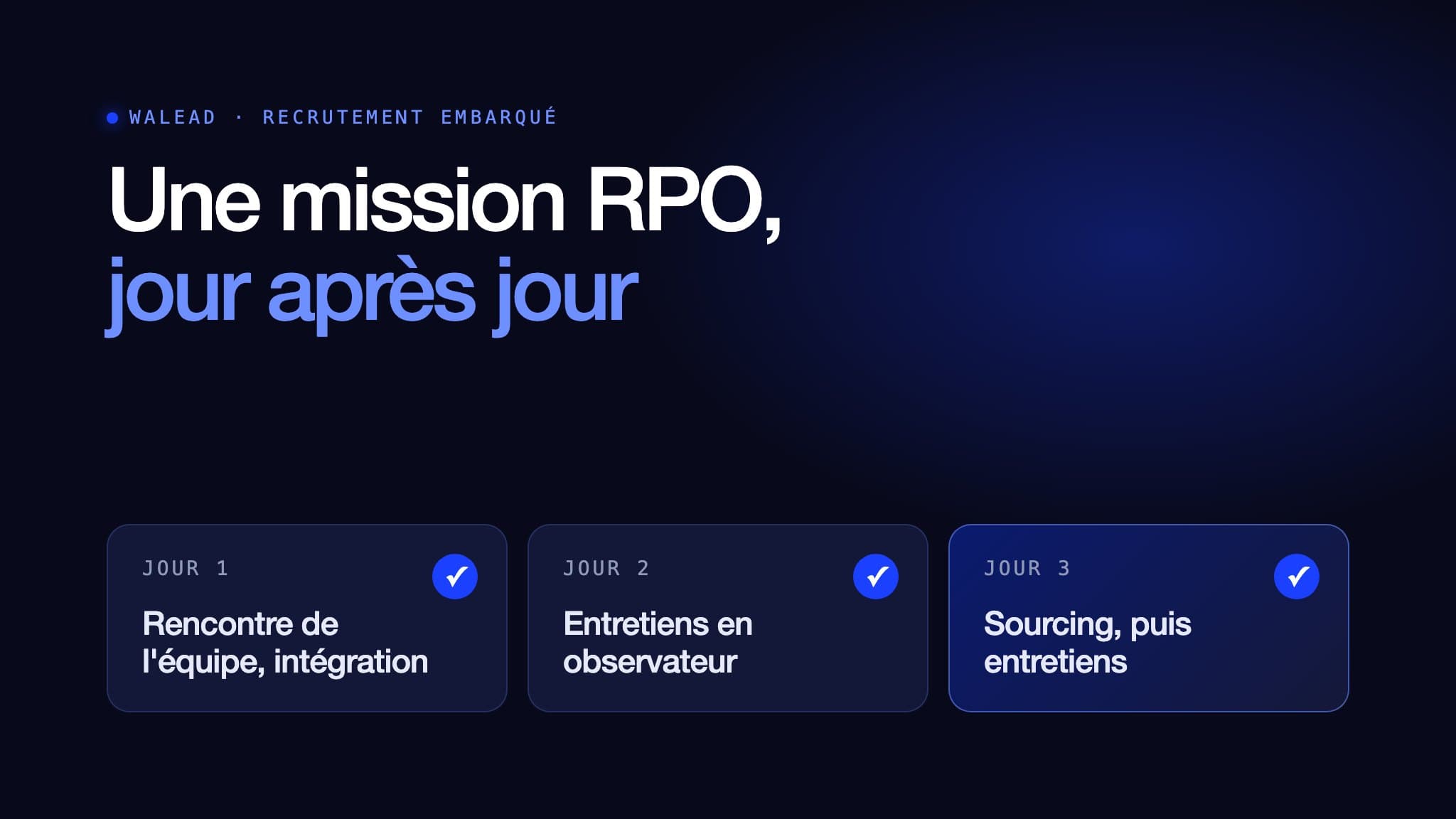
Embedded recruitment (or RPO) brings a recruiter into your company, and many business leaders wonder how it works in practice. The answer: the engagement starts within a week. The recruiter meets your team on day one, sits in on your interviews on day two, then launches sourcing and interviews from day three. After that, you review progress every week, sometimes every day, with figures. Here is the process, step by step.
Embedded recruitment: an engagement that starts within a week
With embedded recruitment, a recruiter joins your company full time for the length of the engagement. The aim is to have a recruiter ready right away: an RPO engagement can usually start within a week. It is a "plug and play" recruiter: they do not need months of training to be useful.
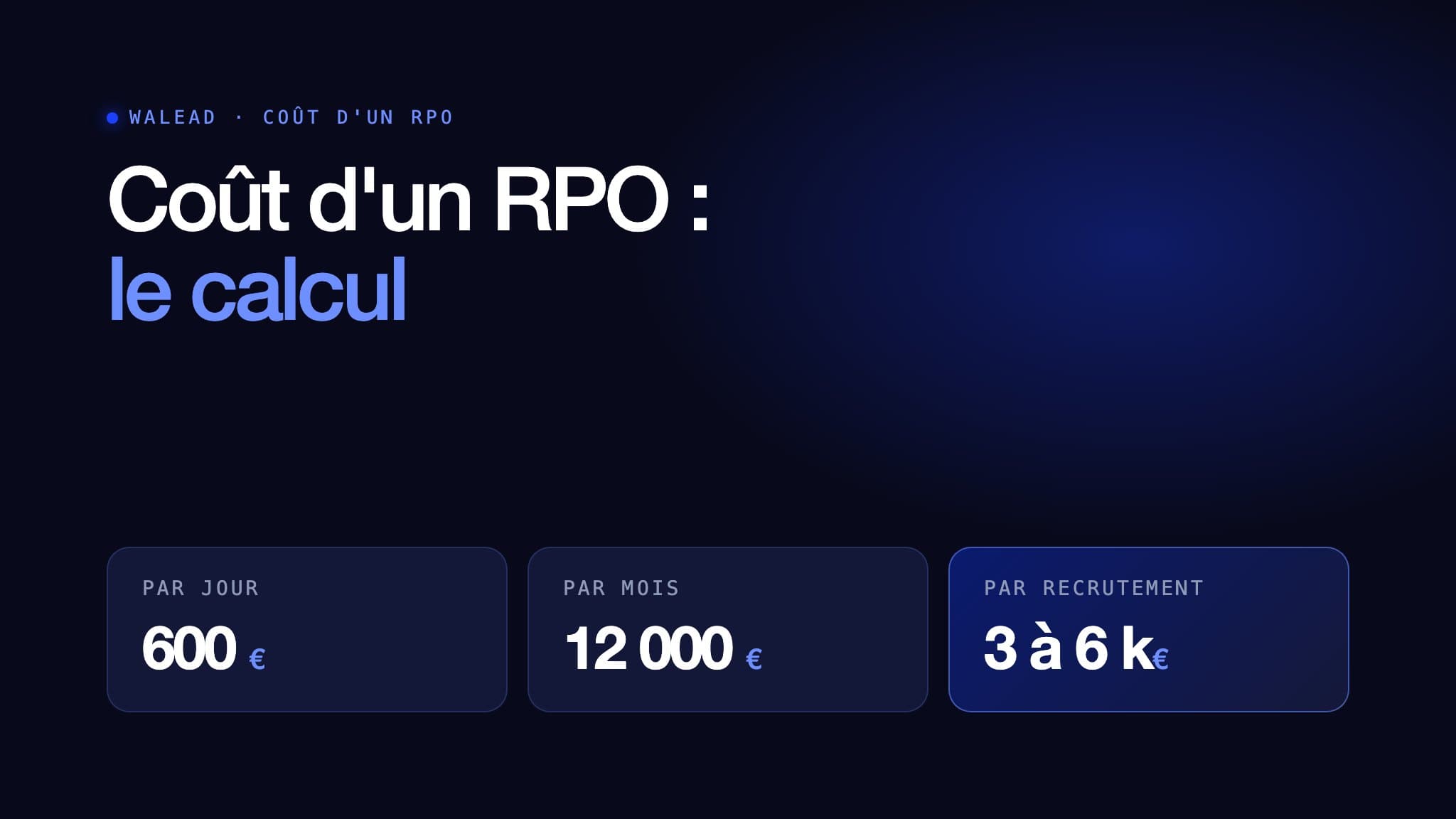
They work in your tools (your applicant tracking system, or ATS, and your Slack) and can come to the office regularly. At Walead, there is no deposit: you pay for the recruiter's time, from €600 per day, with a target of at least 2 hires per month, and up to 4.
Example: you sign the engagement on a Monday. The following Monday, your recruiter is in your premises, with access to your tools.
Day 1: meeting the team and getting integrated
The first day is for getting into the company. The recruiter meets the team, tours the offices and gets their access. They discover your product, your customers and the way your managers work.
That is what makes the difference with an outside agency: because they know your company from the inside, they then present it to candidates more precisely.
Example: before hiring an Account Executive, the recruiter spends time with the Sales team. They can then explain to candidates what they will sell, to whom, and with what targets.
Day 2: sitting in on your interviews
On the second day, the recruiter sits in, as an observer, on the interviews already scheduled. They see how your managers assess candidates, what questions they ask and what they really expect.
This step avoids the common gap between the job description and what the manager is looking for. The recruiter leaves with a clear idea of the right profile, even before launching the search. They also note how your managers present the company, to keep the same message with candidates.
Example: the job description asks for "3 years of sales experience". In the interview, the manager insists mostly on phone prospecting. The recruiter therefore targets profiles that have done prospecting first.
From day 3: sourcing, then interviews
From the third day, the recruiter launches sourcing: they search for and approach matching profiles. The first interviews follow, as soon as candidates reply. Because they work in your ATS, you see each candidate move forward in real time.
The recruiter runs several hires in parallel. So that all candidates are assessed on the same criteria, you can rely on a sales hiring scorecard.
Example: on a three-month engagement, with four roles open, the first candidates are in interviews from the first week, and hires follow one another at the pace of the processes.
Follow-up: a review every week, sometimes every day
You review progress with the recruiter every week, and even every day when the pace requires it. These reviews rely on shared figures:
Sourcing: how many profiles have been identified and approached.
The number of interviews held.
Conversion at each stage: from first contact to interview, from interview to offer, from offer to signature.
Blocking points: a salary that is too low, a process that is too long, a manager who is not available enough.
Candidate feedback on your offer and your process.
The NPS, a satisfaction score.
These figures are tracked the same way from one week to the next: you see right away if the pace slows down, and at which stage.
Example: if many candidates pass the interview but turn down the offer, the problem often comes from the pay or the role. The weekly review lets you see it and fix it quickly.
End of engagement: the handover to your team
The engagement ends when the hires are confirmed. The recruiter then hands over to your in-house team and updates all your tools, starting with your ATS. Nothing is lost: candidates, exchanges and stages stay with you. And if a new need appears along the way, the engagement adapts: the recruiter goes where the need is greatest.
An engagement can also last a long time. At Voodoo, we worked for a year and a half alongside an in-house team of 15 recruiters, reinforcing four departments in turn, 3 to 4 months each. At Ringover, the engagement lasted 3 years, for 120 hires in 4 countries.
Frequently asked questions about embedded recruitment
How long does it take to start an RPO engagement?
An engagement can usually start within a week. The recruiter meets your team on the first day and launches sourcing from the third.
Do you have to pay a deposit?
No. At Walead, there is no deposit with RPO: you pay for the recruiter's time, from €600 per day.
How often do you review progress with the recruiter?
Every week, and every day if needed. Together you track sourcing, interviews, conversion at each stage and blocking points, to fix quickly whatever is stuck.
A recruiter embedded in your team? Let's talk
To understand what sets RPO apart from an agency, read our article RPO recruitment: how it works and when to choose it over an agency. For the budget, read RPO cost: the calculation for hiring your salespeople, and to know when to take the step, When to outsource recruitment: 4 signs to switch to RPO. And if you have several roles to fill, book a call: we prepare the start of the engagement together.