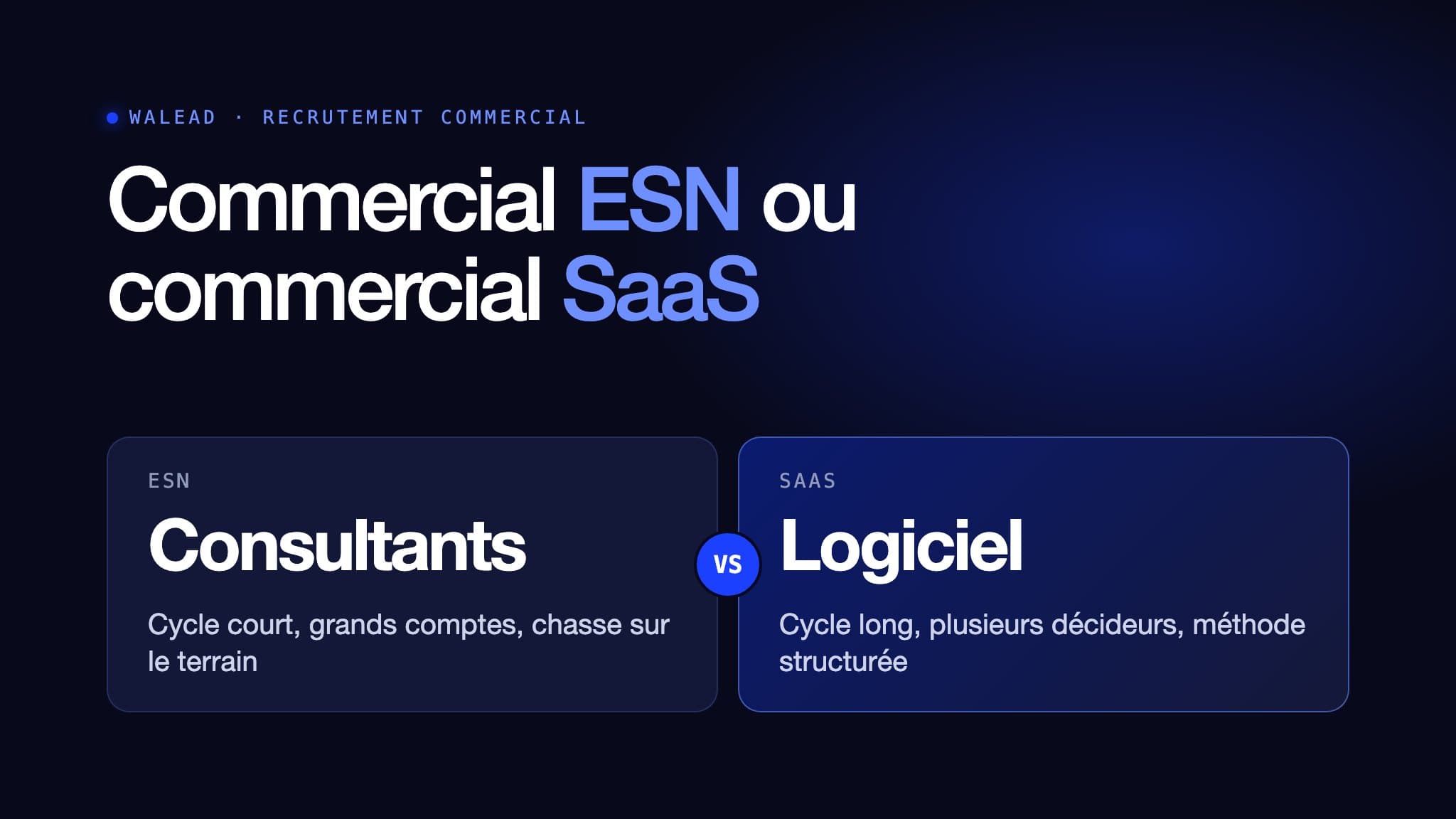
An ESN salesperson (from an IT services firm) and a SaaS salesperson share the same title, but they do not do the same job. The first sells days of consultants, often to large accounts, on short cycles. The second sells a software subscription, on a longer cycle and with more stakeholders. Here is what sets them apart on four points: culture, performance, sales cycle and sales complexity.
ESN salesperson or SaaS salesperson: what they sell
An ESN (entreprise de services du numérique, the French term for an IT services firm) sells expert time: consultants or freelancers placed with its customers, most often billed by the day. The ESN salesperson spots the need, proposes the right profile and signs the engagement.
A SaaS start-up sells a software subscription. The SaaS salesperson signs a contract that renews every month or every year, and the customer only renews if it keeps using the product.
Example: the ESN salesperson places a developer at a bank for six months. The SaaS salesperson sells the same bank software, billed every year as long as it uses it.
Culture: the field on one side, the method on the other
On the ESN side, the culture is more formal: the suit and tie remain common, meetings are more often face to face, and customers are mostly large accounts. ESN salespeople are often big hunters: they go and find needs at customers, in the field.
On the SaaS side, the culture is different: younger, more desk-based, and more structured. Many teams follow a qualification method such as MEDDIC, which requires documenting every opportunity: the quantified gains expected by the customer, the person who signs, the decision criteria and process, the problem to solve and the internal support.
Example: in an interview, an ESN salesperson will tell the story of a meeting won on site at a large account. A SaaS salesperson will rather detail how they qualified an opportunity, step by step.
Performance: placements or recurring revenue
An ESN salesperson is measured on their placements of consultants and on their portfolio of customers: how many consultants are on assignment at their accounts.
A SaaS salesperson is measured on the ARR (annual recurring revenue) they sign, and on upsell, meaning additional sales to existing customers.
These are not the same reflexes: the first thinks in number of consultants placed, the second in subscription amount signed and growth of their accounts.
Example: an ESN salesperson will say "I have 25 consultants on assignment at my customers". A SaaS salesperson will say "I signed €400k of ARR this year". To compare two candidates, ask each for the figure that matches their job.
Sales cycle: short in ESN, longer in SaaS
On the ESN side, the sales cycle is short. When it comes to placing a freelancer, a sale can close in 48 hours: the customer has a project, lacks a skill, and needs someone fast.
On the SaaS side, the cycle is longer. You have to demo the product, convince several people, go through procurement, and sometimes have the software tested before signature.
Example: a customer needs a developer by Monday. The ESN salesperson offers a freelancer and signs within 48 hours. For software, the same customer will want a demo, then the opinion of its technical team and of procurement before signing.
What this changes for you: a salesperson used to short cycles has to learn to follow several opportunities for weeks, without losing the rhythm.
Complexity: software is harder to sell
Our view as recruiters: selling software is more complex than selling consultants. The main reason: the SaaS cycle often involves several stakeholders (the user, their manager, the technical team, procurement, finance), who have to be convinced one by one.
A consultant, by contrast, remains a human being. The customer meets them, judges their background and decides quickly. Software has to prove its value to each of the stakeholders, then confirm it over time for the customer to renew.
Example: for the same customer, the ESN salesperson convinces a single manager who needs reinforcement. The SaaS salesperson has to convince that manager, then their technical team, then procurement.
What this changes when you hire
An ESN salesperson is neither better nor worse than a SaaS salesperson: they have different reflexes. Their strengths are hunting, large accounts and ease in meetings.
For a role in a SaaS start-up, check two points first:
Cultural fit: will they adapt to a younger, more desk-based team with a structured sales method?
The ability to run a complex sales cycle: have they already led a long sale, with several stakeholders?
To assess all candidates on the same criteria, rely on a sales hiring scorecard. We detail this step in our article Hiring an ESN salesperson for a SaaS start-up: what to check.
Frequently asked questions about the ESN salesperson
What is the difference between an ESN salesperson and a SaaS salesperson?
The ESN salesperson sells days of consultants or freelancers, on short cycles and often to large accounts. The SaaS salesperson sells a software subscription, on a longer cycle, with several stakeholders.
How is an ESN salesperson measured?
On their placements of consultants and on their portfolio of customers. A SaaS salesperson, by contrast, is measured on signed ARR and on upsell.
Can an ESN salesperson succeed in a SaaS start-up?
Yes, especially if they are a good hunter and know a sector well. Check first their fit with your culture and their ability to run a complex sales cycle.
An ESN profile for your SaaS team? Let's talk
Hesitating between a salesperson from an ESN and a profile that has already worked in SaaS? Book a call: together we look at what your role really requires. And to learn about market pay, see our Salaries page.